
Anatomy of a Moonshot

Prelude
As I have written, my enthusiasm for AI has been operationally driven, channeling boring task work into automated work streams, with the payoff being more time to explore, create, and build new things. YLCJ and the Insights column is one of those things.
This Insight is dedicated to my mom, Carol Phillips (aka Sissy), on the occasion of her birthday - October 11. Mom’s nurturing influence on me - to read, learn, build, grow - is a part of who I am, and naturally a part of YLCJ.
A recent trip to the West Coast provided another opportunity to learn. It forced me to get outside of my comfort zone and engage in a conversation I was uncomfortable being a part of. Mom was the final person I spoke to before I booked the trip. And it is my aim to share her nurturing influence with you through this Insight!
The Startup
It started out of necessity. When a close teammate decided a career change was in order, I was thrust into the world of SQL and automation. I had been using ChatGPT some, and knew that I had a great teacher. So I designed a self-learning loop to methodically grow new capabilities.
Early on that loop was slow - the time commitment was 95% learning and 5% application. As time progressed, I became more capable of applying what I was learning. That ratio of learning to application has shifted, and I would imagine I am now closer to 50/50 learning to application.
I have learned that the more I solve, the more time I have to tinker and build. More often that building process resembles a treadmill, than the flywheel. Still, the more I build, the more I discover just how many everyday problems have suddenly become solvable. And once you start that learning loop, your eyes are wide open.
AI circles refer to this reality as a capability overhang, and I love that term. The further I climb the proverbial mountain, the more I realize how much more mountain is there. And so, each week, I intentionally seek out a new idea, concept or technique to study and explore.
As I am on a quest to help companies build out AI-native operating systems, I am intentional about talking through what I am learning with those I work with. This adds another important step in my loop. Although there is a great deal of theory to teach in the field of artificial intelligence, whenever possible, I try to teach through experience.
The impact of intentionally climbing that mountain, creating and building, has been rejuvenating … the learning > tinkering > building > teaching loop is extremely rewarding. So I continue to scale that proverbial mountain.
That inherent capability is central to what Your Last Corporate Job hopes to share with everyday men and women.
Influences
Along the way there has been an undeniable influence coming from Peter Diamandis and his bi-weekly Moonshots podcast, featuring the Moonshot Mates: Dave Blundin, Alex Wissner-Gross, Salim Ismail, and relatively new mate Emad Mostaque. Every few days the team at Moonshots distill the rapid advancements happening in the world of AI, and as they do so, they co-deliver a message of optimism.
At a time in society where everyone is divided into camps - with the internet, social media and traditional media accelerating the divide - the message about AI has been mostly negative. The Moonshot Mates provide a pleasant counterweight to that negativity, and there is something highly attractive and productive about the influence of optimists.
All of that being said, I am intentional about not engaging in actions that grow the divide between optimists and doomers, opting instead for actions that bring everyday people together to work towards shared challenges and opportunities (Article III, YLCJ Constitution). So when the opportunity presented itself to attend the inaugural Moonshots LIVE conference, I was cautiously intrigued.
James 4:1 asks, “What causes quarrels and what causes fights among you? Is it not this, that your passions are at war within you?” That verse speaks to situations just like the one I faced. On one hand, being around optimists and influencers was very attractive; on the other hand, it felt like picking a side in the early stages of a battle. And if I attended, it needed to be for the right reasons.
After some deliberations with my friends and family, including a great conversation with my mom who encouraged me to pray about it, I became convicted of the important role that Christians play in the AI conversation - and Moonshots LIVE seemed to be the epicenter of that AI conversation. So I bought a ticket.
The Premiere
For a day and a half in Downtown Los Angeles, roughly 1,500 people convened at the United Artists Theater for the inaugural Moonshots LIVE conference. The unforgettable event kicked off with a red carpet, popcorn, and the premiere of “The Sixty-Year Mission: How Star Trek Changed Television and the World.”
After the premiere, there was a fireside chat between Peter Diamandis, Rod Roddenberry (son of Star Trek creator Gene Roddenberry), and William Shatner (aka Captain James Tiberius Kirk). At 95 years old, the energy and enthusiasm that Shatner had was encouraging for all in the room.
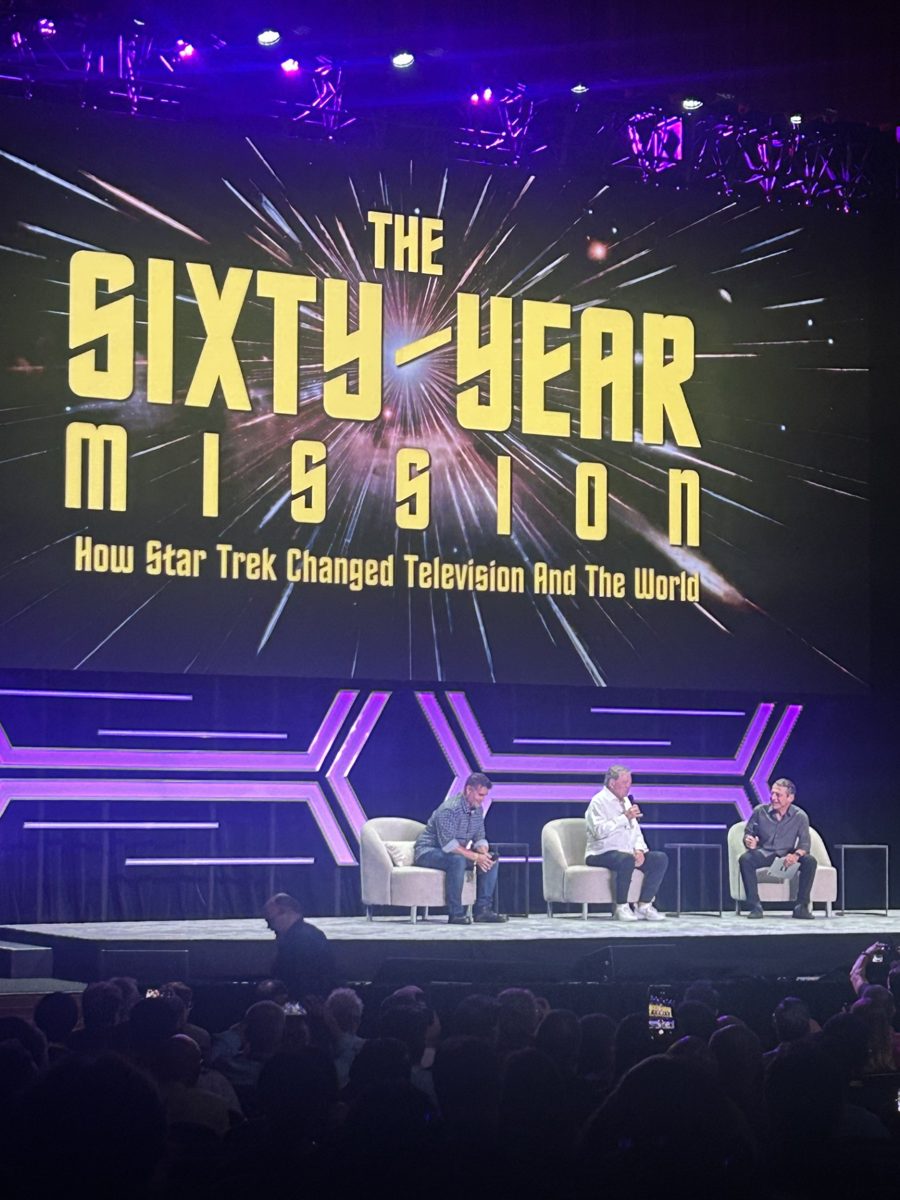
Admittedly, I did not grow up a Trekkie. And to be honest, the whole AI / Sci-Fi thing has not really been a lifelong passion of mine, either. But there is something exhilarating about starting down a new path: to explore strange new worlds; to seek out new life and new civilizations; to boldly go where no man has gone before. And for me that tagline feels more possible today, than it ever has before in my life.
With the premiere behind us, day two of the event was what I was most excited about. So that night I grabbed a pizza and headed back to the room to prepare for the next morning.
Moonshots LIVE
Walking into the United Artists Theater on morning two was sensory overload. People were buzzing with excitement about the day ahead.

On stage, the Moonshot Mates hosted conversational panels of all-star guests, rotating through Palmer Luckey, Ben Lamm, Astro Teller, Cathie Wood, Nikhil Chandhok & many others. My personal favorite was hearing from Neal Stephenson - the author who coined the term ‘metaverse’ in his 1992 cyberpunk classic Snow Crash.
Each of these sessions offered a glimpse of what was possible from each of us - if we focus on creating and building a better future.
Off stage, I was able to meet some incredible people: a filmmaker from Osaka, a recruiter from St. George, a semiconductor engineer from Tempe, a finance executive from Atlanta, an executive coach from Austin.
Each person I met, described with passion, what their next project was - a better vision for humanity; health products that could improve lives; services using AI to solve problems; ideas to improve our environment. And I was able to share YLCJ with others.
The end of the day was capped off with an Unconference concept, where attendees could enjoy food, drinks and hear from various visionaries teaching sessions on building moonshots.
For a complete rundown on the conference, see “Below the Fold” at the bottom of this Insight.
Anatomy of a Moonshot
In my own words, I would define a moonshot as a life-changing solution to a large-scale problem using some bespoke technology.
Please note - I did not say simple-solution, simple-problem, or simple-technology … A moonshot is the convergence of something extremely large - like literally landing on the moon.
Moonshots require a person or group of people maniacally focused on one concept, plus a lot of time and money. They are gigantic ideas that are seemingly solved overnight, but are 10+ years in the making.
They have horrible ROI, until they succeed - think NASA of the 1960s and 70s. Only the smallest fraction succeed. But when they succeed, it is epic!
Alphabet (Google’s parent company) has a company known as X, the moonshot factory. X is the company that started Tidal (ocean health), Waymo (self-driving cars), Wing (drone delivery) & Verily (life sciences). They also built Google Brain, the research team largely responsible for the Transformer … the ‘T’ in ChatGPT … the breakthrough that is the backbone of modern-day LLMs.
I would consider X to be the gold standard of modern-day moonshots. And so at the conclusion of Moonshots LIVE, at one of the Unconference sessions, I attended a masterclass on rapid prototyping, taught by Joe Sargent, Design Kitchen Lead at X.
Rapid Prototyping
Joe Sargent defines a prototype as “anything you make to learn or answer a question”.
Prototypes are not a finished product. To me, they look like sticky notes and scratch pads. They may involve baling wire and duct tape. They are not supposed to be pretty.
The following are Joe’s 8 steps to rapid prototyping, italicized, with a few insights from me following each statement:
- Work out what you need to learn - if you are going to solve some problem, you need to start with a question - what is it you are trying to learn?
- Make contact with the “real world” ASAP - the quicker you get your prototype into the world, the quicker you can address problems that your environment will provide.
- Tackle the monkey first - this one requires a bit of context. The saying at X goes something like “if you are going to try to teach a monkey to recite Shakespeare from atop a pedestal, start with the monkey, then build the pedestal”. In other words, don’t solve the easy part first and pretend that you are halfway through solving the problem. Start with the impossible part first … solve the moonshot.

This above all:
to thine own self
be true.
- Learn to love v0.crap - his words, not mine. Again, prototypes are not supposed to be pretty. They are not the solution. They are the device that helps you find the solution.
- Embrace
failurelearning - this one says easy, but does hard. If you are going to solve something nobody has ever solved, you are naturally going to fail. So embrace it. - Iterate and harvest your learnings - In my experience, this is that learning > tinkering > building > teaching loop I spoke of earlier. Let people know what you have learned.
- Find experts - when you come across an area that may have been solved, consult the smartest person you know - or use an LLM! Intelligence is infrastructure, use it.
- Design your own automation systems - At X, they benefit from a mature intelligence system. Not all of us have that luxury! But we can all start building our own system using an Influence Loop, as we learn > tinker > build > teach. And as you scale your system up, use that internal Influence Loop to build a harness that your whole team can use.
My Moonshot
The application process for Moonshots LIVE included a Q&A section, where I was forced to respond to a very simple, but deep question. “What’s your moonshot? Solve the climate crisis? Make a movie with James Cameron?”
My answer to that question (verbatim):
Prove that AI can’t touch five things: Creation, Building, Judgment, Empathy, Stewardship. They’re still the whole game. And get the everyday person to bet on themselves because of it.
Not as theory. In stages, with my name on each one.
One company first. An AI-native operating system, built end to end. Empire Express.
Then the talent it takes to do that, scaled to 100 more businesses. PaulAnnMedia + PaulAnnLabs.
Then the whole thing, handed to 10,000 entrepreneurs or more. Taught the five pillars, built the way Scripture teaches, not just the way the market rewards. YourLastCorporateJob.
One proves it. A hundred scales it. Ten thousand is the point.
Yes, I used AI to help me make that message pop for the application - I think the punchiness of the answer is the obvious tell. Given the chance to write it out again, I might have polished it a bit more, spoken with a bit more humility. But some artifacts need to be preserved in their original state.
Final Insights
In my experience, creation is the spark, but building is what happens next. And building is extremely messy. Regarding building, YLCJ has previously stated:
“It is working through trial and error; learning on the fly; managing the people component; navigating competing constraints (speed v quality, cost v capability, pipe dreams v pragmatism). It is balancing paradoxical tradeoffs and dealing with the consequences.”
Moonshots require people just like you - attacking complex problems, using breakthrough technology, to help provide a radical solution. So roll up those sleeves, and get to work prototyping. Be sure to encourage others with some nurturing influence. If you are lucky, in 10+ years, you could be an overnight success!
So, what’s your moonshot? Email me at john@yourlastcorporatejob.com
Below the Fold
As advertised for the event, there were also two incredible competitions that took place. Peter Diamandis and Anousheh Ansari hosted two live XPRIZEs. In both competitions, 5 finalists presented to 2 different panels of judges in a shark-tank style format.
The first was the “Build with Gemini XPRIZE” a $2M incentive competition, whose premise was to give builders and creators 90 days + Google Gemini + a clean sheet to stand up a business that solves everyday problems. The judges were Logan Kilpatrick, Palmer Luckey, Mark Pincus & Cathie Wood, and the winner was Lucas Martinic with his company “Polyfork”.
Moonshots LIVE / Build with Gemini XPRIZE
The second was the “Future Vision XPRIZE” a $3.5M incentive competition, where creators were commissioned to build a three-minute sci-fi film treatment depicting an optimistic view of the future (not Terminator). The judges were Mira Lane, Rod Roddenberry, Neal Stephenson & Neil deGrasse Tyson, and the winner was Jeff Synthesized for his film “The Gifted”.
Moonshots LIVE / Future Vision XPRIZE
The event has been very well documented on the Moonshots YouTube page. The following are some links to the various episodes: